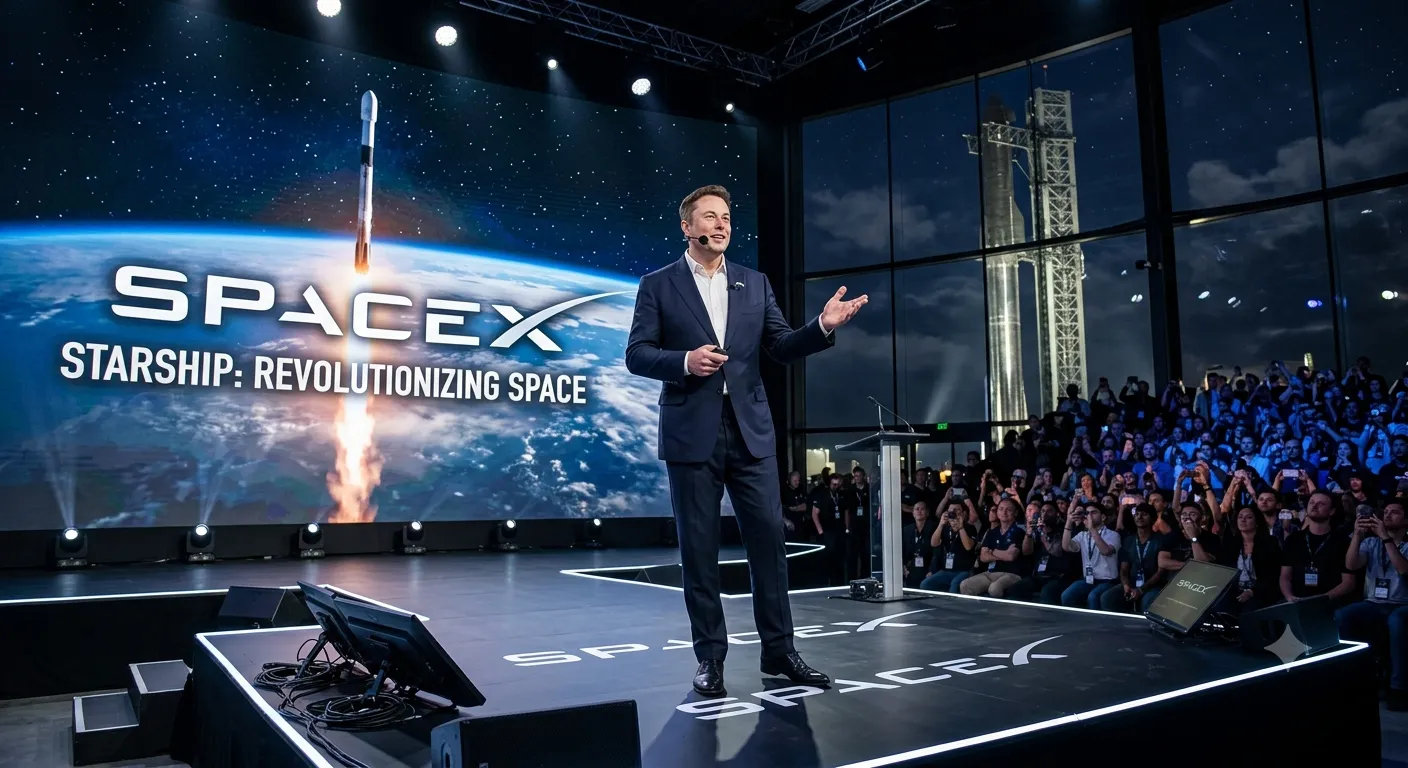
12 June 2026 will go down as a historic date in the history of global finance. On that day, SpaceX went public on the Nasdaq under the ticker symbol SPCX, with a market capitalisation of approximately 1,770 billion dollars. The flotation raised $75 billion, smashing the record held by Saudi Aramco since 2019. But the most significant event was not the IPO itself. It was the consequence: Elon Musk became the first trillionaire in history. His fortune, estimated at around 1,230 billion dollars according to the Bloomberg Billionaires Index, now exceeds that of Buffett, Gates and Bezos combined. You read that correctly. A single man is worth more than three of the most iconic fortunes in modern capitalism, combined.
How Elon Musk reached the 1,000 billion mark
To understand this moment, we need to go back to the summer of 2024. At that time, Elon Musk, Jeff Bezos and Bernard Arnault were vying daily for the title of the world’s richest man, with fortunes hovering around 200 billion dollars. Less than two years later, Elon Musk had increased his wealth sixfold. The catalyst was not Tesla, but SpaceX.
His stake of around 42 % in SpaceX alone is worth more than 760 billion dollars. Tesla accounts for around 280 billion. The remainder is split between xAI, X (formerly Twitter), Neuralink and The Boring Company. The structure of his wealth has shifted: before the IPO, Tesla accounted for 60 % of his assets. Today, SpaceX accounts for nearly 70 % of it. Elon Musk is no longer just the boss of Tesla. He has become the founder of the largest initial public offering ever carried out.
A fortune that is almost impossible to imagine
Figures lose their meaning on this scale. A trillion dollars is the equivalent of spending 27 million dollars every day for a century, according to Bloomberg. That is more than the GDP of Sweden, Ireland or Taiwan. The economic historian Guido Alfani, from Bocconi University in Milan, believes that Elon Musk could be the richest person in the history of humankind, if one excludes emperors and sovereigns whose fortunes were inextricably linked to those of the state.
What makes this wealth particularly staggering is its concentration. When Elon Musk crossed the trillion mark, his wealth was nearly four times that of Larry Page, the world’s second-richest man. According to Oxfam, his fortune exceeds the combined wealth of the 3.8 billion poorest people on the planet – that is, 46 per cent of humanity. This is no longer a difference of degree. It is a difference of kind.
Elon Musk and the contenders for the next trillion
Now that the barrier has been broken, one question springs to mind: who will be the second trillionaire? Prediction markets offer some interesting clues. On Coinbase Prediction Markets, Larry Page, co-founder of Google and currently the world’s second-richest person with a fortune of around $293 billion, appears to be the favourite with an implied probability of 13 %. Jensen Huang, CEO of Nvidia, follows at 6 %, buoyed by explosive demand for artificial intelligence chips. Jeff Bezos, founder of Amazon, is valued at 5 %.
A study published by Informa Connect Academy in 2024, based on an analysis of the average annual growth rates of the world’s 30 wealthiest individuals between 2017 and 2024, put forward more precise projections. It identified Jensen Huang as a potential trillionaire by 2028, followed by Mark Zuckerberg in 2030 and Bernard Arnault in the same year. Gautam Adani and Prajogo Pangestu, two Asian industrialists, also featured on the list.
Why the next trillion will be harder to reach
Before you start imagining a wave of trillionaires, it is important to put these projections into perspective. Elon Musk’s fortune is based on an extraordinarily rare combination: a massive stake in two companies each worth over a thousand billion, almost total control over their strategic decisions, and a historic liquidity event through SpaceX’s IPO.
Gordon Cummins, CEO of Cudio, sums up the challenge in an analysis featured by Quartz: to personally amass 1,000 billion dollars, a person would need to hold between 15 % and 25 % of a company worth several thousand billion, whilst also holding significant stakes in at least one other major company, and without being forced to sell. Shareholder dilution, succession planning, philanthropy and regulatory pressure act as natural barriers. The next decade could produce at most one other trillionaire, not a whole cohort.
Artificial intelligence as a catalyst for wealth creation
If a second trillionaire emerges, the’artificial intelligence is likely to be the driving force. Jensen Huang epitomises this trajectory. Under his leadership, Nvidia has become the essential infrastructure of the revolution IA. Every data centre, every language model, every application machine learning is partly down to its chips. His personal fortune has soared as Nvidia’s market value has risen, and it continues to grow as demand for AI computing intensifies.
Larry Page and Sergey Brin, for their part, benefit from Alphabet’s dominant position in search, cloud computing and generative AI models. Their combined stake gives them 51 % of Alphabet’s voting rights. If AI propels Alphabet’s market capitalisation towards 5,000 billion or beyond, Google’s founders will automatically approach the trillion mark. The race to become the next trillionaire will be a race for dominance of the AI ecosystem.
How the era of trillionaires is changing things for you
Whether you are an entrepreneur, an investor or simply a concerned citizen, this historic concentration of wealth has practical implications. As an entrepreneur, Elon Musk’s career path serves as a reminder of a fundamental truth: the greatest fortunes are not built on prudent diversification. They are built on a extreme concentration in a sector undergoing radical change, combined with total operational control. This is a make-or-break gamble, not a wealth management strategy.
As an investor, the sectors that produced the first trillionaire, namely the private space, electric vehicles and artificial intelligence remain the sectors with the highest valuations. But bear in mind how fragile these fortunes are on paper. Elon Musk cannot sell his SpaceX shares during the post-IPO lock-up period. Most of his wealth is illiquid. A severe stock market crash could wipe out hundreds of billions in just a few trading sessions.
As a citizen, this era raises unprecedented political questions. When a single individual is worth more than the GDP of dozens of countries, the line between economic power and political power becomes blurred. In 2026, US Senator Elizabeth Warren reintroduced the Ultra-Millionaire Tax Act, proposing an annual tax of 2 % on wealth exceeding 50 million dollars. The debate on the taxation of large fortunes is only just beginning.
The era of trillionaires has begun. Elon Musk ushered it in. The next person to reach this milestone will likely be a tech founder who controls a massive stake in a company at the heart of the global AI infrastructure. But between projections and reality lie market volatility, upcoming regulations and the unpredictability of innovation. Nothing is set in stone. Not even for the man who is already worth 1,000 billion.
Sources
- Bloomberg (June 2026). SpaceX IPO Makes Elon Musk the World’s First Trillionaire. Data on Musk’s wealth, SpaceX’s valuation and a historical comparison.
- TECHi (June 2026). Elon Musk’s Net Worth in 2026: An Inside Look at His $1.23 Trillion Fortune. Details of the asset composition and the role of the SpaceX IPO.
- Wikipedia (June 2026). Elon Musk’s wealth. Historical data, comparison with Rockefeller, analysis by Guido Alfani (Bocconi University).
- Visual Capitalist (June 2026). Elon Musk Becomes the World’s First Trillionaire. Forbes’ ranking of the world’s 10 richest people and data.
- Oxfam International (June 2026). Analysis of wealth concentration: Musk is richer than 46 % of the world’s population (3.8 billion people).
- Informa Connect Academy (2024). A forward-looking study on future trillionaires, based on the growth rates of the Forbes fortunes from 2017 to 2024.
- Coinbase Prediction Markets (June 2026). Implied probabilities regarding the identity of the second trillionaire: Larry Page (13 %), Jensen Huang (6 %), Jeff Bezos (5 %).
- Quartz (February 2026). The world’s first trillionaire is on the way. Here’s what it will mean. Analysis by Gordon Cummins (Cudio) on the structural conditions for the next trillion.
- The Global Statistics (June 2026). Trillionaire Statistics in the US in 2026. Data on the concentration of wealth, the Ultra-Millionaire Tax Act and the political context.