You're launching your business. Or looking to expand. And very quickly the question arises: should you first build a website solid, or focus all your energy on social networks ? This is not a trivial question. It directly affects how you spend your time, your money and your credibility online. And the honest answer is that there isn't just one. It depends on who you are, what you're selling and where you are in your journey.
This article won't give you a universal answer. It will give you the right criteria for finding yours.
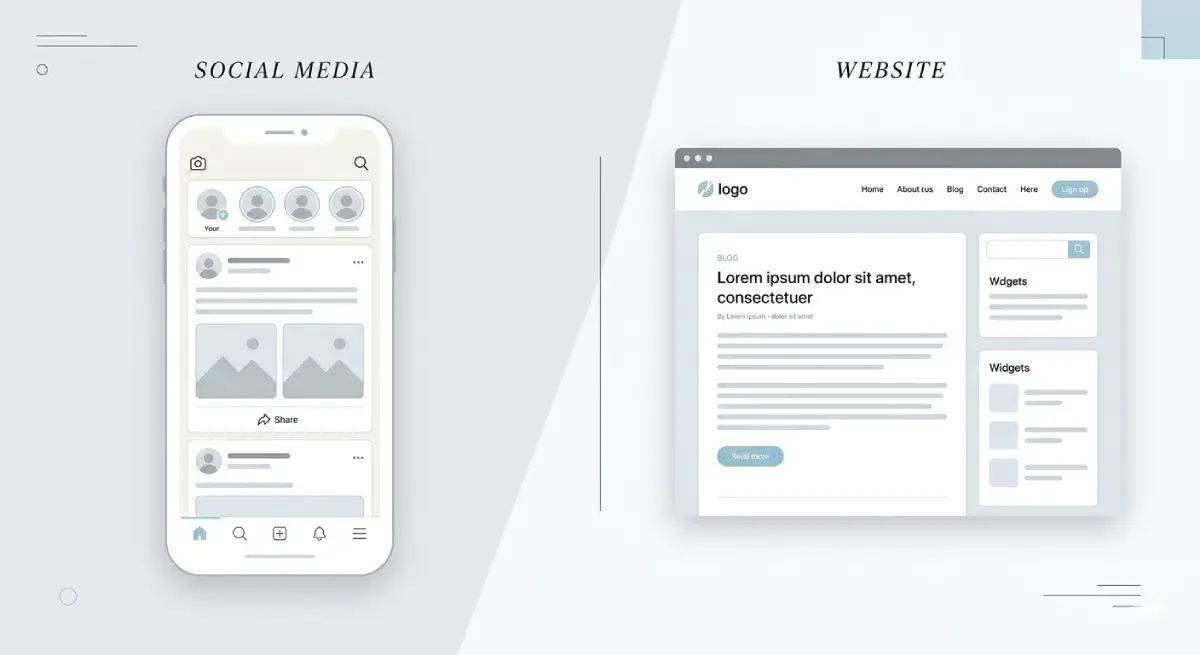
What your website does that social networks will never do
A website is an asset. You own it. Nobody can change its rules overnight, reduce its visibility by changing its algorithm or delete it without notice. It's a space that you control completely, and this fact has a strategic value that many entrepreneurs underestimate when they start out.
According to a study published by Nielsen Norman Group, In fact, users give more credibility to companies with a professional website than to those present only on social platforms. Online trust is built on permanence. A website that has been around for two years, that answers visitors' questions and that clearly presents your offer sends out a signal of seriousness that social networks do not transmit in the same way.
Your website also works when you sleep. A well-referenced page on Google can generate qualified visitors for months without you having to produce content every day. This is what digital marketers call long-term organic traffic, and it's one of the most valuable assets an independent entrepreneur can build.
What social networks do that your website never will
Social networks are discovery engines. A stranger may come across your content without looking for you. They can share it, comment on it or ask you a question directly. This ability to create a rapid and spontaneous human connection is structurally absent from a traditional website.
For an entrepreneur just starting out, with no advertising budget and no established customer base, social networks are often the shortest route to the first sales. You don't have to wait six months for Google to index your pages. You can publish today and get a reaction tomorrow.
Social networks also serve as a laboratory. You test messages, angles and formats. You observe what resonates with your audience before investing in an elaborate sales page or a complete conversion tunnel. This function of rapid experimentation is documented in Seth Godin's work on permission marketing, which emphasises that engagement precedes conversion in almost all modern buying journeys.
Social networks: the question you don't ask yourself enough
Here's a truth that few digital marketing trainers make clear. You don't own your presence on social networks. Instagram can change its algorithm and divide your reach by ten overnight. TikTok can be banned in your country. LinkedIn can change its visibility rules. Facebook has already done this several times, much to the dismay of companies that bet everything on this platform in the early 2010s.
In 2012, thousands of brands built large communities on Facebook. Then the platform reduced the organic reach to less than 5 % to push businesses towards paid advertising. Years of work evaporated in a matter of weeks. This is not an anecdote. It's a structural lesson about the risks of building on ground you don't own.
Social networks are powerful distribution channels. They are not a foundation. This nuance changes everything in the way you need to organise your digital strategy.
Social networks and website: the two are not opposites, they complement each other
The real mistake is not to choose one over the other. The real mistake is to consider them as alternatives when they play different roles in the same system.
Social networks attract attention. They create initial contact, arouse curiosity and generate commitment. Your website, on the other hand, converts this attention into concrete action: making contact, making a purchase, subscribing to an email list. One without the other creates an imbalance. Active social networks without a website, and you lose a large part of the value you create. A website without visibility on social networks, and you're waiting for Google to do all the acquisition work on its own.
Consumer behaviour research conducted by the Baymard Institute shows that the majority of online shoppers consult several points of contact before making a purchasing decision. They may discover you on Instagram, but they check out your website before placing an order. Both elements contribute to the same final decision.
So where do you start?
If you're just starting out and your resources are limited, the logical sequence is as follows. Start with a minimal but credible web presence: a simple, clear page that explains who you are, what you do and how to contact you. You don't need a twenty-page site. A clean, professional base is all you need to establish your legitimacy.
At the same time, choose one or two social networks suited to your target audience, not five. It's better to be consistent and regular on LinkedIn if you're targeting professionals, than scattered across all the platforms without any real impact. Social psychology research by Cialdini on consistency shows that perceived regularity reinforces confidence much more than quantity.
Once you've validated your message and your offer thanks to the feedback from your social networks, invest more in your website. Develop your service pages, create SEO-optimised content and build an email list. You'll be turning a volatile audience into a long-term asset.
What your choice says about your long-term vision
The way you answer this question reveals your relationship with time. Social networks reward immediacy. The website rewards patience. Entrepreneurs who build sustainable businesses generally learn to navigate between the two temporalities without sacrificing one for the other.
You can start with social networks if you need quick results. But if you want to build something that will still exist in five years' time, regardless of the whims of the platforms, your website must gradually become the centre of gravity of your digital presence.
Social networks are the shop window. Your website is the shop. One is eye-catching. The other makes the sale. And you need both to make your business really work.