

You've launched your online business, you've got a quality product or service... but your sales aren't taking off. The problem? You may not yet have a sales tunnel. This concept, an essential part of digital marketing, is the key to turning strangers into loyal customers, automatically and scalably.
In this article, I'll explain exactly what a sales tunnel is, why it's essential for your business, and how to build one effectively.
1. What is a Sales Tunnel? Simple definition
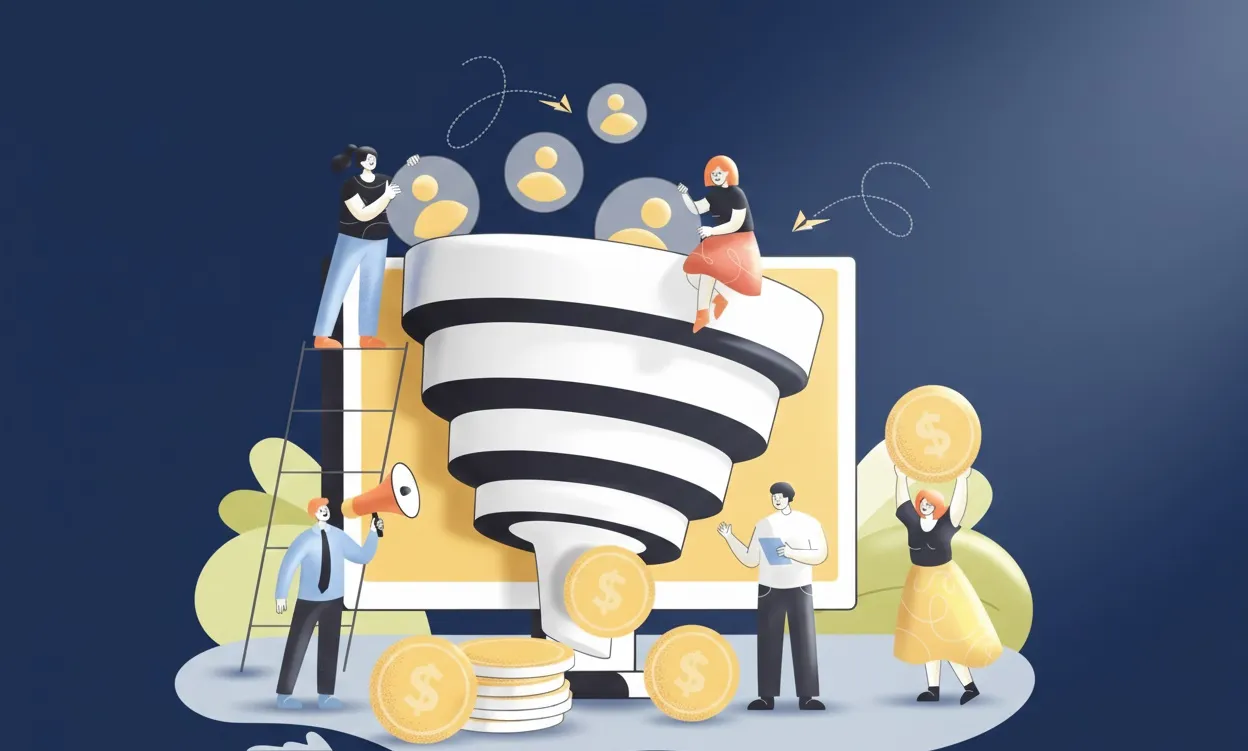
A sales funnel is a structured path that a visitor follows from the moment they discover your offer to the moment they make a purchase - and even beyond.
This is known as a «tunnel» or 'funnel» because, at each stage, some people leave the process. At the end, only the people who are most qualified and motivated to buy remain.
In a nutshell: The sales tunnel is a sequence of steps designed to guide your prospects towards purchase, while filtering out those who are not yet ready.
2. Why use a Sales Tunnel?
Without a sales tunnel, you're relying on chance. With a well-constructed sales tunnel, you put in place a predictable and automatable system that works for you 24 hours a day.
Here are the main benefits:
- Increase your conversion rate: each stage is optimised to convince.
- Automate your sales: the tunnel works even when you're asleep.
- Qualify your prospects: you only talk to people who are genuinely interested.
- Maximise customer value: through upsells and complementary offers.
- Reduce your acquisition costs: a good tunnel makes your advertising profitable.
3. The 4 Key Stages of a Sales Tunnel
The classic structure of a sales tunnel is based on the AIDA model: Attention, Interest, Desire, Action. Here's how these stages work in practice.
Stage 1: Awareness (TOFU)
The visitor discovers your existence. They arrive via advertising, social networks, search engine optimisation (SEO) or word of mouth. At this stage, your aim is to capture their attention and offer them something of value in exchange for their contact details (often their email address).
Common tools : landing page, lead magnet (free ebook, checklist, free training), Meta or Google Ads.
Stage 2: Interest and Nurturing (MOFU)
The prospect has joined your list. Now you need to nurture the relationship. This is the «nurturing» phase: you send them emails, useful content, testimonials and case studies. The aim is to build their confidence in you and your offer.
Common tools : automatic email sequences, webinars, sales videos, blogs, podcasts.
Stage 3: Decision and Buy (BOFU)
The prospect is ready to buy. You present your offer clearly, with an optimised sales page, social proof, a guarantee and a strong call to action. This is where the transaction takes place.
Common tools : sales page, secure payment page, limited-time offer.
Stage 4: Loyalty (Post-purchase)
A satisfied customer is your best asset. After the purchase, you can propose additional offers (upsell, cross-sell), thank them, ask for their opinion and turn them into ambassadors for your brand.
Common tools : welcome email, loyalty programme, exclusive customer offer, private community.
4. The different types of sales tunnel
There is no single type of sales tunnel. Depending on your business and your objectives, you can use :
- The lead generation tunnel: capturing emails via a free lead magnet.
- The webinar tunnel: registration → live or automated webinar → offer.
- The product launch tunnel: a sequence of content over several days prior to a sales opening.
- The tripwire tunnel: a small, irresistible offer at a low price to turn a stranger into a customer, then upsell to the main offer.
- The direct sales tunnel: sales page → order page → upsell.
- The discovery call tunnel: the prospect makes an appointment for a consultation (ideal for coaching and premium services).
5. What tools should I use to create a sales tunnel?
There are many tools on the market for building your sales tunnel, even without technical skills:
- ClickFunnels the international benchmark, all-in-one but expensive.
- Systeme.io the most accessible French solution, ideal for beginners (free version available).
- LearnyBox e-learning, which is very popular in France.
- GoHighLevel : powerful for agencies and advanced coaches.
- WordPress + WooCommerce + CartFlows: a flexible solution for those who master WordPress.
The best tool is the one you actually use. Start simple, then evolve as your needs change.
6. Concrete example of a Sales Tunnel
Let's take the example of a personal development coach who sells a training course for €297:
- Stage 1 - Facebook advertising → Optin page with a free ebook «5 habits to boost your productivity».
- Stage 2 - Sequence of 5 emails over 7 days → sharing advice, customer testimonials, training presentation video.
- Step 3 - Final email with link to the training sales page → limited offer with bonus if purchased within 48 hours.
- Step 4 - Confirm your purchase → upsell to individual coaching at €97 → join a private community.
Once in place, this simple system can generate sales automatically, even outside working hours.
7. Mistakes to avoid with a Sales Tunnel
Many entrepreneurs set out to create a tunnel without achieving the results they had hoped for. Here are the most common mistakes:
- Propose an offer that doesn't meet the needs of your audience.
- Neglect the opt-in page: if no-one registers, the tunnel cannot function.
- Forget email follow-up: most sales are made after several points of contact.
- Giving up too soon: A tunnel can be optimised over time using A/B tests.
- Try to make everything complex from the outset: start with a simple, effective tunnel.
8. Sales Tunnel vs Classic Website: What's the Difference?
It's a question that many people ask themselves. A traditional website is like a shop window: it presents your products and services, but does not actively guide the visitor towards a purchase. A sales tunnel, on the other hand, is a signposted path with a single objective at each stage.
- Website: multiple pages, free navigation, lots of distractions.
- Sales tunnel: streamlined pages, a single call to action, linear path.
The two are complementary: your website attracts and informs, your tunnel converts.
The Sales Tunnel, Your Best Salesman
A well-constructed sales tunnel is like having a salesperson working for you 24/7, without ever getting tired or taking time off. It's the most powerful tool for developing your online business in a predictable and scalable way.
Whether you're a coach, trainer, consultant or e-tailer, you have everything to gain by setting up your own sales tunnel today.
Ready to create your sales tunnel? Contact me at on roger-ari.com for personalised support and to take your business to the next level.
What is a sales tunnel in marketing?
A sales tunnel in marketing is a structured process that guides a prospect from their first interaction with your brand through to purchase, via defined stages of awareness, interest, decision and action.
What is the difference between a funnel and a sales tunnel?
These two terms mean exactly the same thing. «Funnel» is the English term, «tunnel de vente» or «funnel de vente» are the French equivalents. Both refer to the customer journey from discovery to purchase.
How much does it cost to create a sales tunnel?
The cost varies according to the tools used and your level of support. With Systeme.io (free version), you can create your first tunnel free of charge. For more advanced solutions, expect to pay between €27 and €300 a month, depending on the platform you choose, or from €700 if you want to call on the services of an expert.
How long does it take to create a sales tunnel?
A simple sales tunnel (optin + email sequence + sales page) can be created in 1 to 2 weeks if you have the right support and motivation. Optimisation, on the other hand, is a continuous process that improves with time and data.






I agree that you need to start simple, but one question comes to mind: for a premium service activity (such as consulting), do you recommend using a direct discovery call tunnel or systematically going through a lead magnet to ‘warm up’ the audience? I look forward to reading your next tips on optimising conversion rates!
Thank you for this comprehensive article!