There are public figures that time eventually erases. And then there are others whom time seems to validate more and more with each passing decade. Oprah Winfrey falls into the latter category. In 2026, when the debate on female leadership is occupying boardrooms, lecture theatres and social networks, her name keeps coming up. Not as an icon of nostalgia, but as an operational, documented and always relevant model.
Why? Because what Oprah Winfrey has built is not based on luck or fame. Because what Oprah Winfrey has built is not based on luck or fame. It's based on a leadership philosophy that is coherent, measurable and deeply rooted in what management science research today calls transformational leadership. In this article, we take a closer look at this model.
From a fractured childhood to a $3 billion empire
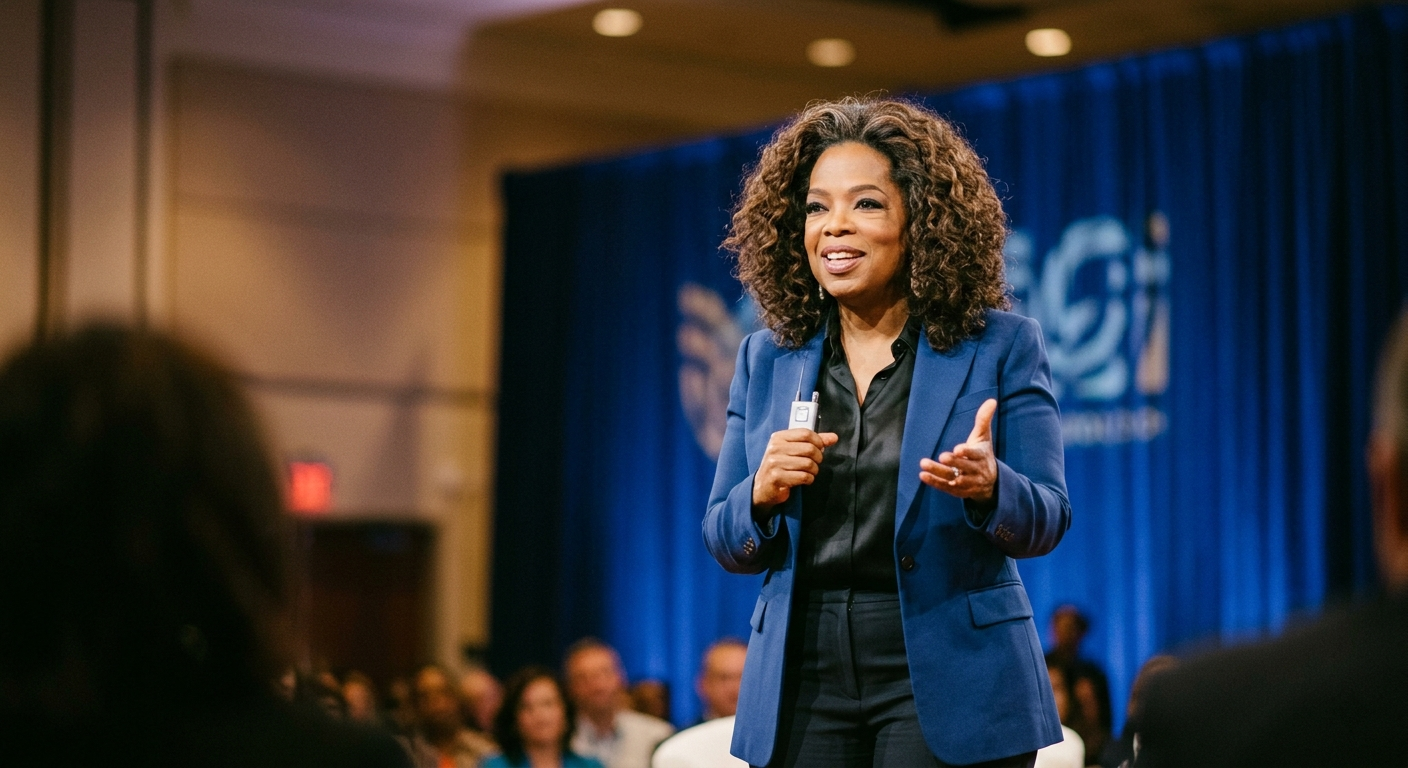
Before talking about female leadership, we need to talk about starting points. Hers is a brutal one. Born Oprah Gail Winfrey on 29 January 1954 in Kosciusko, Mississippi, Oprah grew up in poverty and instability, confronted very early on with violence that could have defined her trajectory in an entirely different direction.
This background is not a biographical detail. It is the foundation of everything she has become as a leader. Her early experiences have given her a deep understanding of suffering and resilience, fuelling her determination to help others overcome their own hardships. This transformation of injury into drive is one of the most well-documented characteristics of his leadership style.
Her fortune is estimated to be worth around $3.1 billion by mid-2025, according to available financial analysis. What makes her success unique is not simply the size of her fortune, but the way she has built it: by transforming her role as a talk show host into a diversified media empire, while maintaining a brand that is both resilient and expansive.
Women's leadership
What sets Oprah Winfrey apart from most of the media figures of her generation is a decision she made very early on, one that few observers have fully appreciated. In 1986, she founded Harpo Productions, a multimedia production company. This strategic choice enabled her to secure the property rights to her show, control production and distribution, and build up a vast media portfolio.
She became a millionaire at the age of 32, not because of her fame, but because of her early insistence on ownership of her show and production company, a decision many artists don't make until much later in their careers. This entrepreneurial reflex, this refusal to be simply employed in one's own story, is one of the most concrete lessons that female leadership can learn from its journey.
The Harvard Business School, in its portrait of 20th century leaders, describes her as having created a multimedia empire through Harpo Productions, starting with a morning talk show in Chicago to build one of the most enduring and successful programmes in the history of American television. The academic institution does not cite his charisma. It cites his vision and his ability to transform that vision into a sustainable economic structure.
Transformational leadership: what research confirms
The term is not insignificant. Transformational leadership is a specific category in management science, defined and studied since the work of James MacGregor Burns in the 1970s and formalised by Bernard Bass in the 1980s. This type of leadership is about changing and transforming people. Transformational leaders provide a sense of vision and mission, inspire through communication of high expectations, stimulate problem-solving intelligence, and give personal attention to each employee. This type of leadership is about emotions, values, ethics, norms and long-term goals.
Oprah Winfrey embodies transformational and authentic leadership, combining empathetic communication with strategic vision to build a global media empire while transforming millions of lives. Her leadership philosophy puts people above profits, leads with vulnerability, and creates meaningful change through authentic connection.
It's not a flattering afterthought. It's an accurate description of what management researchers have been observing in his business decisions, his team management and his relationship with his audience for four decades.
Women's leadership
Oprah Winfrey once said: Leadership is empathy. It's the ability to relate to people and connect with them in order to inspire and empower their lives. This phrase is not a slogan. It's the synthesis of what decades of research in organisational psychology have shown: emotional intelligence is the number one predictor of leadership effectiveness, ahead of analytical intelligence and technical expertise.
Emotional intelligence is one of the key characteristics of a successful leader. Oprah has a remarkable ability to use her emotional intelligence in her interactions with people. It is one of her key qualities for maintaining professional and human relationships over the long term.
You see this principle at work in every aspect of what she built. One of the factors in the success of her show was her direct conversational style, which created a genuine connection between her and her audience. By using a style that departed from the usual talk show format, Oprah was able to connect with her audience, particularly through empathetic body language, active listening and openness to people from different backgrounds and points of view.
Authenticity as a leadership strategy
The word authenticity is often overused in discourse on women's leadership. With Oprah Winfrey, it has a precise content and a measurable economic value. She has consistently shown that being honest and transparent about her own experiences fosters trust and connection. Her frank discussions about her weight difficulties, the sexual abuse she suffered as a child and her personal relationships have built a bridge between her and her audience. This openness helps others to feel seen and heard, encouraging them to embrace their vulnerabilities rather than hide them.
This approach has produced what analysts in the business press have called the Oprah effect. The Wall Street Journal coined this expression to describe her ability to transform everything she touches. When Oprah talks, people listen. This is not influence in the superficial sense of the term. It is the result of a relationship of trust built up over decades of consistency between the values espoused and the decisions taken.
She has built her empire by being herself without compromise. Being authentic means aligning your actions with your values and beliefs, which Oprah demonstrates in exemplary fashion. Adopting this authentic leadership style means staying true to your values and seeing your team's trust and respect grow naturally.
Philanthropy as an extension of leadership
You can't talk about Oprah Winfrey's female leadership without talking about her relationship with philanthropy. It's not an accessory to her fame. It is a structuring dimension of her entrepreneurial vision. She has donated over 400 million dollars to charitable causes, mainly focused on education, notably through the Oprah Winfrey Leadership Academy for Girls in South Africa.
In 2025, it remains active, producing content for Apple TV+ and supporting its leadership academy. Its recent documentary on artificial intelligence and the future of humanity, broadcast in 2024, demonstrates its continuing ability to address contemporary issues with relevance. A leader who, at over 70 years of age, produces a documentary on artificial intelligence is not someone who lives on what she has. She is someone who maintains the intellectual posture that leadership demands.
What this model teaches you in concrete terms
If you're looking to develop your own female leadership, Oprah Winfrey's model offers you precise operational guidelines, far from vague injunctions.
The first benchmark is ownership of your value. Entrepreneurs should seek to control their intellectual property and creative assets, to adapt and innovate in the face of challenges, and to align their strategic decisions and investments with their values. Oprah refused to be an employee of her own creation. She demanded to own it.
The second benchmark is active resilience. She has a unique combination of empathy, determination and the ability to keep going when everything around her has collapsed. Resilience is not a passive state. It's a renewed decision every morning not to let circumstances write the end of your story.
The third benchmark is long-term vision. She was brave enough to dream big and intelligent enough to climb the steps one by one. The combination of ambition and method is what transforms a vision into lasting results.
Women's leadership
Female leadership as embodied by Oprah Winfrey is not a softened version of male leadership. Nor is it its radical opposite. It's something more specific: leadership that puts empathy, authenticity and collective impact at the heart of strategic decisions, without abandoning ambition, control and vision.
His approach to leadership transcends traditional hierarchical structures, demonstrating that real influence does not require positional power to be effective. This lesson applies far beyond meeting rooms. It applies to every woman who wants to occupy a professional space that reflects who she really is.
Conclusion: a benchmark that doesn't age, but evolves
What makes Oprah Winfrey an enduring benchmark for women's leadership is not her wealth or her celebrity. It's the consistency between what she says, what she does and what she builds, maintained over more than forty years of public and entrepreneurial activity.
Her leadership style is a powerful combination of authenticity, empathy, vision and resilience. Her remarkable journey from adversity to global icon is a testament to the transformative power of empowerment.
You don't have to become Oprah. But you can choose to study what she has built with the rigour that this model deserves, to draw from it the principles that resonate with your own trajectory, and to apply them with the same consistency that she took decades to embody. That, in the end, is the real value of a benchmark: not to imitate it, but to draw inspiration from it to write something that is uniquely your own.