Every euro invested in online advertising is a gamble. And you know it. And faced with two giants like Google and Meta, the question always comes up: where do you put your money to get real results? It's not a question of fashion or personal preference. It's a strategic decision that can make the difference between a profitable campaign and a squandered budget.
This article is designed to help you make the right choice, without unnecessary jargon and with solid data and criteria to guide your choice.

Understanding the fundamental logic of each platform
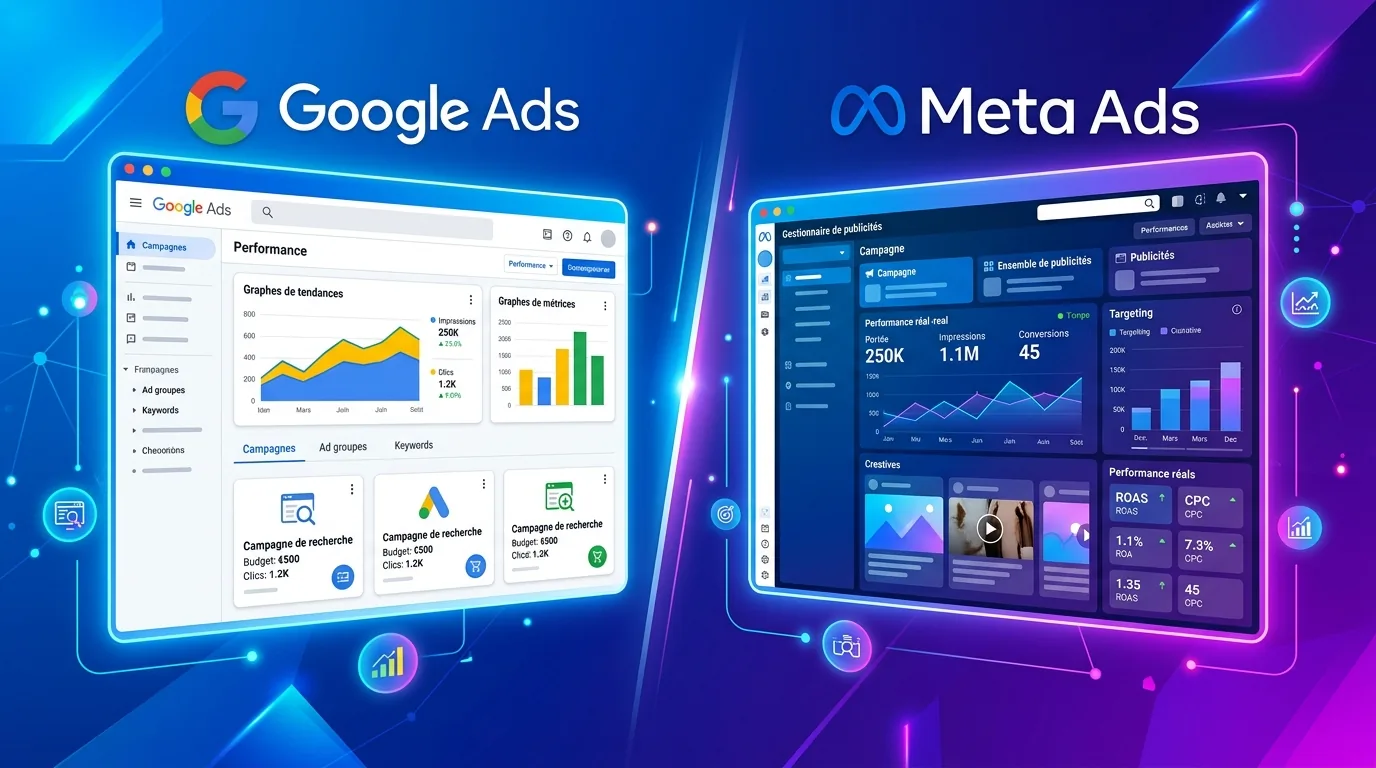
Before comparing Google Ads vs Facebook Ads, We need to understand what distinguishes them in their very DNA.
Google Ads is based on intent. When someone types in «best accountant in Lyon» or «buy waterproof hiking boots», they are expressing an immediate need. You're capturing a demand that already exists. This is what marketing experts call «pull marketing»: you attract people who are actively looking for what you have to offer.
Facebook Ads, on the other hand, works on intelligent interruption. Your ad is inserted into a stream of content that the user hasn't asked for. You create demand rather than capturing it. This is the « push marketing« . The challenge is different: to arouse desire, not to meet a stated need.
This distinction changes everything in your approach.
Google Ads vs Facebook Ads: the figures that really count
According to data published by WordStream In 2023, the average conversion rate on Google Ads across all industries is around 3.75% for the search network. On Facebook Ads, it fluctuates between 9 and 10% for certain sectors such as retail, but can fall below 1% for complex or high value-added offers.
These figures do not mean that one is better than the other. They do mean that your objectives should guide your choice.
If your priority is to generate immediate sales from people who know what they're looking for, Google Ads often offers a more predictable return on investment. If you're looking to build an audience, launch a new product or raise your profile at a lower cost per impression, Facebook Ads gives you powerful leverage.
Your budget, your sector, your stage of development
The Google Ads vs Facebook Ads question also depends on your economic reality.
On Google Ads, the cost per click (CPC) can be high in highly competitive sectors. Keywords related to insurance, law or finance can exceed €10 to €50 per click, according to SEMrush data. If your monthly budget is limited, you run the risk of generating little traffic before your resources are exhausted.
Facebook Ads often allows you to start with more modest budgets. You can test audiences, refine your visuals and collect usable data for just a few dozen euros a day. But be careful: a low cost per click means nothing if the conversion rate is low and the purchase path is poorly designed.
Ask yourself this question honestly: are your potential customers actively looking for what you're selling, or do you have to make them want to buy first?
Complementarity that few companies exploit
Many entrepreneurs treat the question of Google Ads vs Facebook Ads as a binary choice. This is a strategic mistake.
The most successful companies use the two platforms in a complementary way. Facebook Ads to raise awareness of a product, create desire and reach cold audiences. Google Ads to convert people who already know about your product, who may have seen your advert on social networks and who are now coming back to search for your brand or your solution on Google.
This approach is based on a reality documented by the Nielsen office Multi-channel campaigns generate on average 35% more brand recall than single-channel campaigns. You're not choosing between two tools. You orchestrate a system.
Concrete criteria for deciding now
If you had to make a decision today, here are the objective criteria to weigh up.
Choose Google Ads if your product or service responds to an active search, if your sales cycle is short, if your customers type specific queries into a search engine, or if you operate in a sector where demand is high and can be verified using tools such as Google Keyword Planner.
Turn to Facebook Ads if your product is new or little-known, if you're targeting a specific niche by socio-demographic criteria or interests, if you want to build community loyalty, or if your offer lends itself well to impactful visual content: video, before/after, product demonstration.
In both cases, your landing page must be up to the job. A brilliant ad that leads to a slow, confusing or unconvincing page will never convert. That's the golden rule that both platforms can't tell you enough.
What recent data reveals about buying behaviour
The study Think with Google published in 2022 shows that 53% of online shoppers say they carry out research on Google before finalising a purchase, even when they have discovered the product on social networks. This confirms that Google Ads is not just a conversion tool: it is often the last step before purchase.
Meta reports that 70% of Facebook users say they have discovered a new product or service on the platform. Facebook Ads excels in the discovery phase.
Comparing Google Ads with Facebook Ads reveals two different moments in the buying journey. Understanding at what point you want to intervene in this journey is probably the most important question to ask yourself.
Measure to progress, not to reassure yourself
Whatever platform you choose, your best ally is rigorous measurement. Connect your campaigns to Google Analytics 4, correctly set up your conversion events, and install the Meta pixel on your site from day one. These tools mean you're not flying blind.
Beware of vanity metrics: impressions, likes or gross clicks don't pay the bills. What counts is your real cost per acquisition, your conversion rate and your return on advertising investment (ROAS).
Conclusion: the right question is not «which», but «how».»
The real answer to the question Google Ads vs Facebook Ads is neither Google nor Facebook. It's: which platform best serves your objectives at this precise stage of your development, with your current budget and for your specific audience?
Start with one platform, test, measure and adjust. Then consider the second when you have a solid base. Digital marketing does not reward those who make the right choice once and for all. It rewards those who learn quickly and adapt continuously.
You now have the information you need to decide with lucidity. The next step is up to you.