
Since 28 February 2026, the world has been holding its breath. The American-Israeli strikes on Iran immediately placed a geographical point 50 kilometres wide at the centre of all economic anxieties: the Strait of Hormuz. This arm of the sea linking the Persian Gulf to the Indian Ocean is much more than just a maritime passage - it is the jugular artery of the world's energy supply. And today, this artery is bleeding.
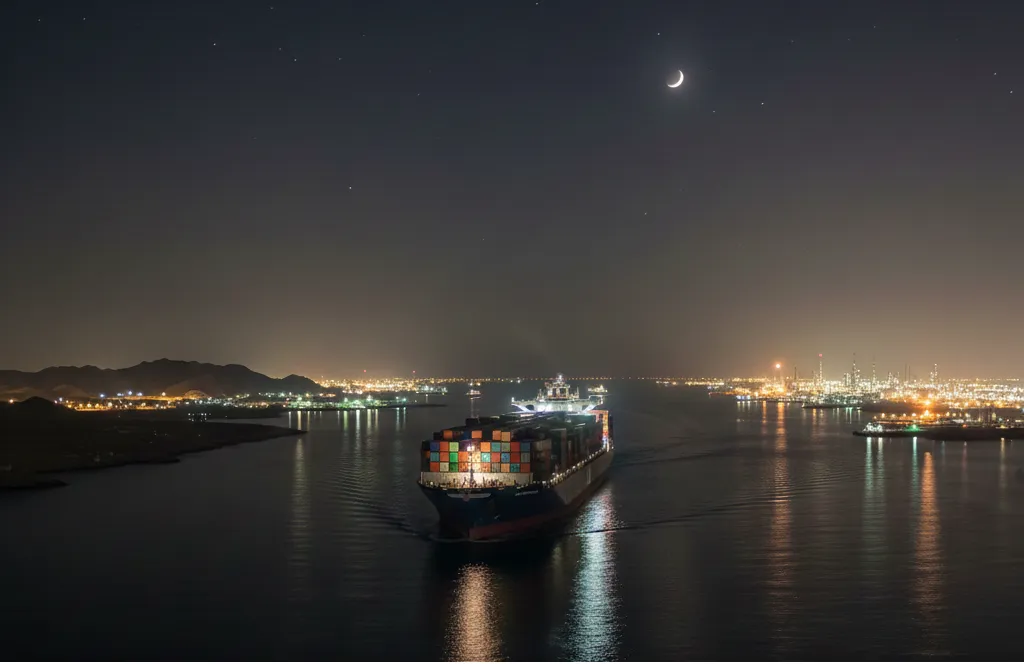
In this article, we explain why the Strait of Hormuz represents a real time bomb for the global economy, what the possible scenarios are, and what this means in concrete terms for your wallet, your energy bill and the financial markets.
Key figures: a passage worth billions
| 20 % of the world's oil transits through Hormuz | 20 M barrels/day blocked each day of the blockade | +13 % rise in Brent as soon as the markets open |
1. What exactly is the Strait of Hormuz?
The Strait of Hormuz is a shipping channel barely 50 kilometres wide at its narrowest point, bordered to the north by Iran and to the south by Oman and the United Arab Emirates. Its shallowness - less than 60 metres - makes it vulnerable to any attempt to block or mine it.
What makes this strait absolutely irreplaceable is the concentration of oil exporters who depend exclusively on it: Saudi Arabia, Iraq, the United Arab Emirates, Kuwait and Qatar have virtually no credible alternative for exporting their hydrocarbons. Around a quarter of the world's oil and a fifth of its liquefied natural gas (LNG) pass through the region every day.
| 💡 Did you know? Despite years of geopolitical warnings, no alternative pipeline has been developed on a sufficient scale to compensate for the closure of the Strait. Saudi and Emirati bypass capacity covers only a marginal fraction of the volumes usually transported. |
2. De facto closure: a bomb already in the making
Since 1 March 2026, the Strait of Hormuz has not been technically closed - but it has been de facto shut down. The Iranian Revolutionary Guards have been broadcasting radio messages prohibiting ships from crossing it, and although these warnings are not legally binding, the result is the same.
What really happens on the water
Maersk, the world's second largest shipowner, has suspended all sailings through the Straits. The United States has called on commercial ships to stay away from the Persian Gulf. Marine insurance companies have increased their premiums by around 50 %, and some are now refusing to insure ships that venture into the area. The attacks on 1 and 2 March targeted four separate ships, including one oil tanker directly affected.
Result: the net impact is an effective loss of 8 to 10 million barrels of crude oil supply per day, According to analysts at Rystad Energy, even if hypothetical bypass infrastructures were fully mobilised.
| 📊 Immediate impact on the markets At the start of trading on Monday 3 March, Brent crude soared by more than 13 % to over 82 dollars. European gas jumped by more than 39 %. The Paris Bourse lost 3.46 %, Frankfurt 3.44 %, and Seoul fell 7.24 % in two days. |
3. Possible scenarios for the global economy
Scenario 1 - Rapid resolution (within 2 weeks)
If American air and naval superiority succeed in rapidly securing the passage, a partial resumption of commercial traffic is conceivable. The markets could stabilise at around $85 to $90 a barrel while the diplomatic situation is clarified.
Scenario 2 - Prolonged lockout (1 to 3 months)
This is the scenario that economists fear most. A complete halt to exports from the Gulf States for several weeks would trigger a major supply crisis, even if the OECD's strategic reserves (90 days of theoretical stocks) were mobilised. The price of a barrel of oil could exceed 100 dollars for a long time, reviving the spectre of the oil shocks of 1973 and 1979.
Scenario 3 - Prolonged tanker war
Iran could opt for a strategy of attrition: not closing the Strait completely, but making passage sufficiently dangerous and costly to discourage shipowners. This scenario is reminiscent of the tanker wars of the 1980s. It would maintain a high risk premium on energy prices for months, fuelling global inflation.
4. Who suffers most? The geography of vulnerability
Not all economies are equal in the face of this crisis. Here is a ranking of the most exposed regions:
- Asia: the front line. China ships 57 % of its oil through the Strait of Hormuz. Japan, South Korea and India depend on the Strait for 70 % of their oil imports. A prolonged shutdown would instantly paralyse their industrial base.
- Europe: risk of a gas crisis. The closure of Qatari LNG facilities following the explosion of a missile near the Ras Laffan complex on 2 March is a particular threat to Germany, whose gas reserves are at their lowest level as winter draws to a close.
- The United States: a political Achilles heel. Less energy-dependent, the United States remains vulnerable to inflation. Kpler's experts believe that Iran is seeking precisely to keep prices high in order to coerce Donald Trump, whose electorate has been promised low prices.
- Iran itself: the double penalty. The Iranian regime depends entirely on the Strait for its own export revenues. A prolonged blockade is also a double-edged sword for Tehran.
5. Decarbonisation and war: the real lesson of the crisis
Beyond the immediate shock, the Strait of Hormuz reveals a truth that economists have been repeating for decades: as long as our economies remain dependent on hydrocarbons from the Middle East, they will be at the mercy of every geopolitical convulsion in the region.
Emmanuel Hache, Director of Research at IRIS, puts it clearly: decarbonisation is the only structural lever that will enable us to reduce this vulnerability in the long term. Every dollar invested in renewable energies, energy storage and energy efficiency is an insurance premium against the next Hormuz crisis.
| 🔎 Long-term outlook Which sectors are faring best in this crisis? Renewable energies, cybersecurity, defence companies (Thalès and Dassault Aviation have seen their shares rise) and oil majors like TotalEnergies. The energy transition is no longer just a question of climate change - it is now a question of national and economic security. |
6. What investors and entrepreneurs need to remember
If you manage a budget, a business or an investment portfolio, here are the signals to watch out for in the coming weeks:
- Brent crude price above 100 $: psychological threshold triggering an upward revision of consumer prices throughout the global supply chain.
- Marine insurance premiums: a leading indicator of the perception of risk on the ground, more responsive than diplomatic declarations.
- OECD strategic reserves: the mobilisation of these stocks (theoretically for 90 days) will be the first signal of a coordinated attempt to stabilise the markets.
- TTF (European gas): after a jump of +41 % in one session, any return to the levels of the Ukrainian crisis would be a major warning signal for the European economy.
- The role of China: Beijing transports 90 % of Iranian oil. Its diplomatic position in the coming weeks will be decisive for the outcome of the conflict.
Conclusion: Hormuz, mirror of a fragile world
Le Strait of Hormuz is not just a dot on a map. It is the symbol of a global economy that has built its prosperity on highly concentrated geographical and energy dependence. The crisis of March 2026 is a stark warning: 50 kilometres of sea can shake stock markets from Tokyo to Paris, send energy bills soaring from Berlin to Shanghai, and threaten years of growth.
The question is no longer whether the Strait of Hormuz will again be at the heart of a crisis - but when. And what we will do, collectively, to ensure that we are not so vulnerable next time.









Interesting article, but frankly we hear the same thing every time there is a crisis in the Middle East. «In 2019 it was the same with the strikes on Abqaiq and in the end the barrel was back to normal in 3 weeks.
Except that this isn't a drone attack on a refinery, it's direct strikes on Iranian territory. You can't compare. Iran has anti-ship missiles that can hit any oil tanker in the Gulf in a matter of minutes. That's another dimension.
...
I run a very small transport business and my diesel bill has already risen by 18% since Monday. What you're debating in macroeconomic theory, we're experiencing in cash. Thanks for the article, at least someone has clearly explained why.
It's also the fault of the politicians who banned nuclear power in Germany and curbed our energy independence in France. We have 20 years of bad decisions to pay for now. The article is right about decarbonisation, but it will take at least 30 years. What are we going to do in the meantime?
I'll tell you what we do: we pass the cost on to the customer or we close. It's as simple as that.
What the article fails to make clear is that Trump NEEDS oil to remain expensive in the short term in order to justify the military operation to his electorate. But he also NEEDS it to fall in order to keep his economic promises. He has put himself in a total contradiction.
You're wrong about everything. Trump wants low prices for the US economy, and the Saudis can afford to open the floodgates to compensate if the Straits remain blocked. That's exactly the deal. Stop seeing conspiracies everywhere.