Artificial intelligence is no longer a subject reserved for laboratories or specialist conferences. It is invading businesses, public services and even social debates. Two figures crystallise some of these discussions: Elon Musk and Bill Gates. Their positions are closely scrutinised because they are based on decades of technological experience and real economic influence. Their analyses sometimes diverge, but they converge on one central point: human work is going to change profoundly.
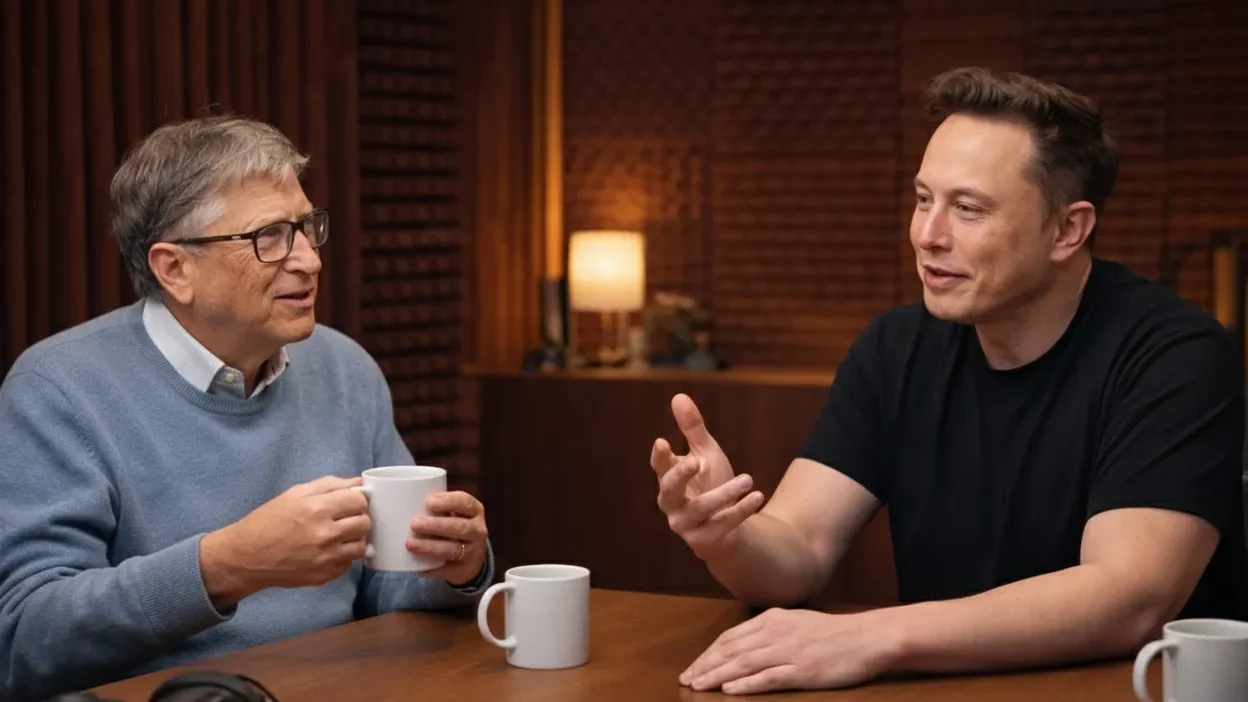
Elon Musk and Bill Gates: two views of an automated future
When Elon Musk and Bill Gates discuss the future of work, they start from a common observation. AI systems are progressing rapidly, sometimes faster than the ability of organisations to adapt. Musk regularly emphasises the speed of this development. He talks of a tipping point where many routine intellectual tasks become automatable, in the same way as certain physical tasks were in the previous century. Gates takes a more gradual approach, but recognises that the spread of AI will change the very structure of jobs.
The two entrepreneurs agree on one verifiable point: generative AI and machine learning systems are already capable of producing text, code, analyses and recommendations that can be used in business. This reality is no longer theoretical. It can be seen in the tools deployed today, from programming assistants to data analysis solutions.
Professions transformed before being eliminated
The idea of a massive and brutal disappearance of jobs is often put forward in public debate. But this is not the case, Elon Musk and Bill Gates qualify this scenario. The data available shows above all a transformation of existing professions. Repetitive functions are the first to be affected. Basic accounting, first-level customer support, production of standardised content. In these areas, AI is acting as an accelerator.
Gates underlines a precise point: AI does not replace an entire profession, it replaces tasks. This distinction is essential. An accountant is still needed, but his role is shifting towards analysis, control and advice. A developer is still essential, but spends less time on repetitive lines of code. This reading is based on practices that can already be observed in technology and industrial companies.
Musk, for his part, goes further in his projections. He evokes a world where the majority of material needs could be met by automated systems. This is still a forward-looking scenario, but it is based on concrete advances in robotics and AI applied to production.
Increased productivity and the new value of work
One of the most measurable effects of AI concerns productivity. Several public studies show significant time savings for employees using intelligent assistance tools. Elon Musk and Bill Gates see it as an economic opportunity, but also as an organisational challenge.
Increased productivity does not automatically guarantee a better distribution of value. Gates insists on this point in his speeches. Without appropriate policies, the benefits of AI may be concentrated among a few players. This is why he defends the idea of massive investment in training and education, so that workers can adapt to the new tools rather than being subjected to them.
Musk is adopting a more radical stance in the long term. On several occasions he has raised the possibility of work becoming optional for part of the population. This hypothesis is accompanied by a debate on redistribution mechanisms, such as universal income. These comments are documented in his public speeches, even if their implementation remains largely hypothetical.
Education as a key variable
When it comes to education, the positions are closer than they appear. Elon Musk and Bill Gates believe that current education systems are not fully adapted to the age of AI. Gates emphasises the use of intelligent tutors capable of personalising learning. Experiments are already underway, particularly in the teaching of maths and science.
Musk is more insistent on the need to rethink the skills that are valued. In his view, pure memorisation is losing its relevance in the face of systems capable of providing instant answers. Creativity, the ability to formulate good problems and make complex decisions are becoming central. This analysis is in line with findings shared by many researchers in the educational sciences.
AI and social responsibility
The question of responsibility plays an important role in the discourse of both entrepreneurs. Elon Musk and Bill Gates recognise that AI can amplify existing imbalances if deployed without safeguards. Algorithmic biases, excessive surveillance, technological dependence. These risks have been documented and are the subject of active research.
Gates often highlights the role of institutions and governments in regulating these technologies. He advocates clear, data-driven rules to limit misuse. Musk, who is more critical of regulators, nevertheless calls for serious supervision of the’IA which it sees as a long-term security issue.
Human labour versus the machine
A question that comes up regularly is: what will be left of human work when machines can do things better and faster?. Elon Musk and Bill Gates respond differently, but without head-on contradiction. Gates believes that professions linked to care, education and human relations will continue to be of great value. These areas rely on empathy, trust and context, dimensions that are still difficult to automate entirely.
Musk, more provocatively, suggests that even these areas could be partially transformed. He does not deny the importance of humans, but he questions the idea that work is the main source of meaning. This vision, which is often criticised, is part of a wider reflection on social organisation in a highly automated world.
A transition to be managed, not endured
What emerges from the verifiable positions taken by Elon Musk and Bill Gates, is the idea of a transition rather than an instantaneous break. L’IA is progressing in stages. Companies that adapt gradually are already reaping measurable benefits. Companies that ignore these developments are taking a strategic risk.
So the key question is not whether AI will transform work, but how. Ongoing training, adapting business models, protecting the most exposed workers. These levers have been identified and documented. Their implementation will depend on political and economic choices that go beyond the technological framework.
Towards a new balance
Looking at the public declarations and concrete initiatives, one thing is clear. Elon Musk and Bill Gates are not proposing a single vision of the future of work, but they are helping to structure the debate. AI appears to be a powerful tool, capable of improving productivity and freeing up human time. It also raises fundamental questions about the value of work, the distribution of wealth and the role of education.
The future of work will neither be entirely automated nor frozen in current models. It will be shaped by the collective choices, informed or otherwise, that accompany the deployment of artificial intelligence. On this point, the analyses of Elon Musk and Bill Gates offer less definitive answers than points of reference for understanding what is already happening.